Showing posts with label political Friday. Show all posts

Friday, November 13, 2015

How To Live Like An Asylum Seeker In The Australian Community

I see so many people cry that people seeking asylum in Australia get all the benefits! They get free housing! They get everything!

Well, that's utter bullshit.

Try this.

You have to flee your country, because there has been a threat to your life. Maybe your brother went missing last week, and there is no news about where he is, or if he is still alive.

There are phone calls to your family; there are scary, anxious moments when you go out to the market. This has been going on for months and months, but is escalating. You haven't been able to go out of the house for work for months.

You are scared. Really scared. Your life is in serious danger. So you decide to flee.

Maybe just you, and your family scrape together all the money they can, and what they can borrow, to send you. In the hope that you will be safe, and you may one day help them get to safety too.

So you find a way to pay for a passage to Australia - the "Lucky Country". A country where you will be safe, and free, and you can start a new life, get a job and start helping your family back home.

You need to go through so many steps to get to Indonesia, so many scary moments, before you are actually placed on that rickety boat in the middle of the night, with a heap of other people who have done very much the same as you to get there.

Since July 19 2013, it has been a randomised lotto about whether you were quickly sent to Nauru or Manus Island, or whether you remained on Christmas Island. And if indeed you were allocated to stay back, even when people from the boat you came on went sent offshore, you would now be living in the Australian community.

Our Minister of Immigration, and his Opposition, try to pretend this did not happen. But you will find anyone here in our community who arrived on the very same boats as those held without hope. So goes the many lies of this political football in our country.

Once you get out of detention, which could be months after you arrive, could be years - no rhyme or reason again about why there is a difference, you will either live with someone you already know here in Australia (a community link), or you will first be placed in a hotel for up to 6 weeks. Now, you must figure out how to live in Australia.

A totally foreign place, with more rules and regulations and paperwork than you can imagine. You need to open a bank account, with minimal acceptable ID and no history of living in Australia. Then you need to find somewhere to live. How do you find a rental property in Australia, with no rental history?

Once you have a bank account, and you have worked you way through the lines and processes at Centrelink, you now receive around 85% of the Newstart allowance, so about $429 per fortnight. You need rent and bond to get started. You will also need to find a place that fits within your allowance, so you can eat, travel around to appointments and hope to find work. You have no option but to find something very cheap, in outer areas, and with many other people. You certainly have no bargaining power to increase a bid for a rental property, as is the trend here in the cities of Australia!

But you are starting with nothing. So imagine you need to figure out how to furnish your new place with the bare necessities, usually with the help of charities in the community.

Once you have settled, you've found somewhere to live, and you are setting yourself up with further English classes to help with living in Australia, and you are starting to figure out how to find a job. How do you find a job in Australia with no work history in Australia? Maybe your schooling back in your home country was not recognised formally, because you were stateless, or simply because you need to go through many impossible steps to have it acknowledged in Australia. Maybe you didn't get to go to school, due to your family circumstances, or because you needed to work to help your family. Finding work is a very big challenge.

Depending on your visa, you should get an Interim Medicare card for medical assistance. But this doesn't cover everything, and many providers in the community have no idea what this means, You will need to pay full price for any medication, unless you have a support service set up an arrangement for you. For an emergency, of course, you can go to a hospital to be treated - but just hope you are not taken via ambulance, cos we all know how expensive that is!

And then you wait. Wait for your chance to be determined to be a refugee.

Oh! But because you have arrived by boat, even if you are deemed to be a genuine refugee, you still are not given permanent protection to stay in Australia. You will have to go through your refugee determination every couple of years, for the next visa temporary option. Under constant uncertainty about your future; never quite settled, really.

All the while, you have the shadow of Border Force and Immigration hanging over you. You know people back in detention that have been re-detained for the smallest things - for driving without a licence, for a drink driving charge, for being in a fight, for being in the wrong place at the wrong time, or for no good reason given at all. This fear hangs over your head, reminding you of the very fears you held for your life back home.

Not so easy now, is it?

Australia needs an amnesty on it's treatment towards people seeking asylum, who are here, and stuck in our offshore island set-ups. Before we can return to being a country we can be proud of.

Treating people like this is not saving anyone.

Friday, April 17, 2015

Posing With A Lion Cub, And Other Ethical Animal Travel Decisions

Getting close the a wild animal on your travels sounds exciting. I have seen lots of photos posted on Facebook by my friends, and other bloggers, with pictures of themselves sitting beside an adult tiger or cuddling a lion cub. And these snaps ARE pretty impressive.

If you can allow your eyes past the chain around the tiger's neck.

But is it right?  Are wild animals meant to be cuddled by humans? Are you helping, or harming them, by doing this? Is this something you want to take part in, really, when you are travelling the world, collecting experiences?

I hope these are questions people ask themselves more and more, as these opportunities present themselves all over the world.

The Thailand Tiger Temple in Kanchanaburi has been in the news this month, with authorities looking to close it down due to mistreatment. Stories of the animals being drugged, chained very closely, taunted and teased with food have existed for some time.

Then there is the Giraffe slayer who has been recently internet-shamed by Ricky Gervais, for posting of her recent kill - an activity people all over the world seem to get excited and outwardly proud about. There are many instances of people hunting, killing and then posing with animals. But almost always, these are contrived situations where the odds are stacked against the animal for the tourist's benefit.

In Cambodia, just outside of Phnom Penh, you can go to a shooting range, and I understand you can pay $100US (well, this was the talk back when I was living there) to shot and kill a cow with an AK-47. I am always stunned that people take this up, and then brag to the world about their "feat".

My time being driven through Kruger National Park and seeing the wide range of animals living and interacting with their natural environment, was incredible. Going with a tour guide who was a conservationist, and so evidently a lover of the animals she observed from her vehicle, was brimming and admirable.

This was how wild animals are meant to be living. Co-existing, hunting for their own meals, living in the food chain of the jungle. Natural.

Our guide was respectful of the animal's space, habits, habitat and behaviours. Careful, and cautious, so as not to disturb. A perfect, real, and exhilarating experience as a tourist.


Whilst I was planning some time in East London, I actually looked into visiting a place for that super cute selfie with a lion cub.

A couple of us starting reading up on these places around the country, and were quickly horrified at what we found about the industry.

I read articles about the industry of these "petting parks". Where they bred these lions to be sold to the many private reserves around South Africa. The parks where tourists can come and sign up to hunt and kill them, in closed off designated land for this purpose. A canned hunt, it's called.

Bred to be petted as a cub, and then confined to an area ready to be hunted down and killed by tourists.

No, I don't want any part of that supply chain.

The differences between conservation and mistreatment need to be investigated as you travel around, looking for unique experiences. Up close comes at a cost - to the animal.


Leaving only footprints, take only photos from the places you visit - but considered, ethical ones, that do not endanger, or support the death of that animal and others like it.

Friday, April 03, 2015

Take A Stand. Raise Your Voice. Join The March - Movement Towards A Fair Australia For The Asylum Seeker Debate

There was a massive march through Melbourne on Sunday, with 15,000 people using their feet and voices, to raise the need for change about how Australia treats asylum seekers and refugees. This was echoed around the country, and the world, as people gathered in cities such as Perth, Canberra, Darwin and Adelaide, to march as well. Plus, ex-pats and concerned world citizens posted gatherings protesting about the policy of prolonged detention by Australia on various social media.

The momentum feels like it is growing, and the tide turning towards a more compassionate Australian public, little by little.

Apart from marching on this one day, here are a few other little actions you can take on, to help make a difference and keep this movement towards a more just approach to asylum seekers going:

Read more widely. Currently, our government has bans on the information coming out of the detention centres, and the mainstream media seems to support this wholeheartedly. The need to read more widely, from a range of different sources, to find out the truth about what is actually going on, and wade through the different opinions and thoughts on the debate, has been thrust upon us.
Also read the two reports on the situation of detention in Nauru, released very recently - firstly, the Australian Human Rights Commission's The Forgotten Children report, and then the damning Moss Review into the allegation of sexual abuse in the Australian detention centre. The evidence speaks for itself.

Know the facts. There is so much politicised language being repeatedly used in this debate, that the truth and humanity about the issue gets lost, intentionally, I am sure. The Asylum Seeker Resource Centre's Hot Potato Fact Sheet will help you here, to be armed with the truth about the numbers, the costs, the "queue", and the fear being sold to the public.

Read about some of the places and issues people are fleeing from. Places like Syria and Iraq and Palestine are in the news frequently, and so it should be easy to review your understanding about these situations. Issues faced by the Rohingya and Tamils in Sri Lanka are not so widely covered in the present media, and might be a little harder to find, so I have linked a couple of my posts there to get you started.

Write to your local MP, or let them know your thoughts on the debate. At the end of the march in Melbourne, advocate Pamela Curr urged people to go and visit the office of their local government representative and tell them that you care about the way Australia is mistreating people in detention. She said that MPs say they rarely hear about the asylum seeker debate from their constituents.
You can also write to them, which I have done, to let them know your thoughts and concerns. This site, They Vote For You, will tell you where your Member sits on the issues debated in parliament, and thus will help you shape your appeal or congratulations, on a humane stance towards the people turning to Australia for assistance and protection.
I now await a response from mine, which included an offer to meet and chat about my work experience to help inform her of the situation.

Get to know someone for whom these policies affect directly. Visit someone in detention. There are people held all around Australia, some for years and years without release nor information about why they are being detained, with very little to do, and fast dwindling hope and faith in the good of the world. You can go and spend an hour or two with someone, and make a difference in their day. And in yours, while you are at it!
Several asylum seeker agencies and advocacy groups around the country can assist with this, like DASSAN in Darwin, who have a great program in place. You will be supported, and have peer meet ups, to ensure you are well equipped and supported when doing this.
There are actually many ways you can spend time with people who are asylum seekers or refugees in our community, too - join a Welcome Group event or program, sign up for The Welcome Dinner Project, become a tutor to school children in the community. The possibilities are endless, when you start looking!

Oh! And you can share this post! Tell other people how they too, can get active in the debate and fight for change.

I would love to hear how this post has inspired action, if it has - please drop back and let me know what your MP said in response, or tell me about a visit you have made. Share a conversation you've had where you have helped someone see things differently, or tell me about a situation you have read up on that you didn't know about before!

And.......ACTION!

Friday, November 21, 2014

Occupy Central - Hong Kong's Umbrella Movement


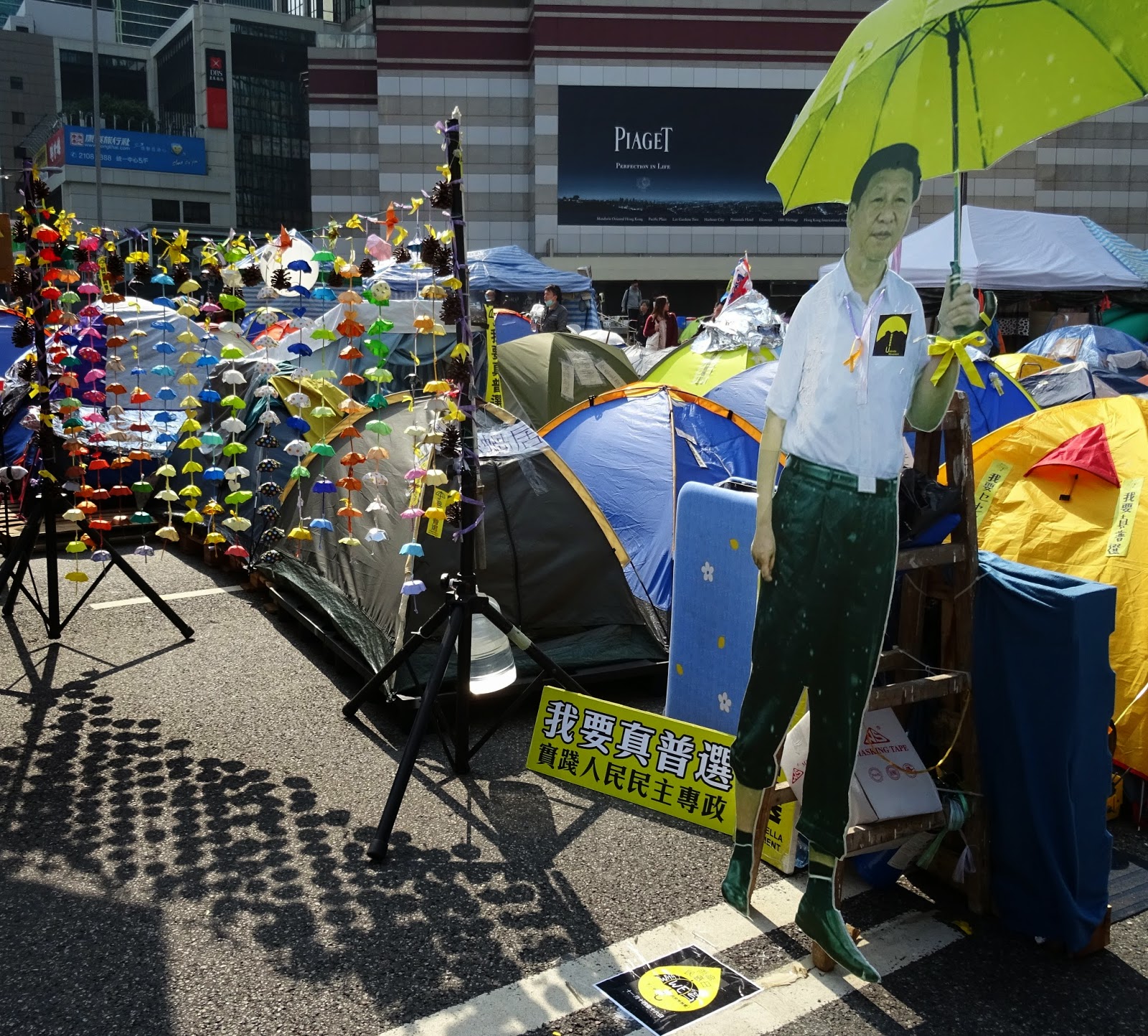
Being in Hong Kong this week, I managed to walk down through the Occupy Central site, where tens of thousands of students are camping out to protest the democratic process in Hong Kong, whereby they can vote directly for their Chief Executive, rather than having a group China approves for election. This pro-democracy fight is to seek to be governed by the people Hong Kong choose. This protest began in September, and is now into it's 55th day today.

The yellow umbrella has become a symbol of the protest, mainly because of it's use to protest the unarmed protesters against pepper-spray yielding police, who were in full riot gear trying to move the protestors along just 6 days into the mass sit-in. The everyday Hong Kong umbrella was their protector.

The symbol of the umbrella, and the vision of one protester walking through a cloud of tear gas with an umbrella raised, has been likened to the image of Tank Man in the Tiananmen Square. Powerful stuff!

Walking through the protest area was pretty easy, as many people were walking in, and very many office workers were sitting eating lunch around the tents. Lending their support.

The set up of the site is pretty impressive - there are recycling waste stations, there are several First Aid tents, and all the way through there are structures build to allow safe passage across the usual road barrier between lanes. There is a Social Work tent.

Students are the majority of those camped, and so in the middle of it all there is a study tent and library, which seemed to hold the most people when I walked through.

In addition to all this are the amazing art displays, and powerful and inspiring slogans of peace, hope and freedom. The Lennon Wall is a stairway covered in post-it notes filled with messages.

The umbrella symbol is used everywhere in the pro-democracy signs and messages. And then, it's also used in art, such as this sewn-together canopy between two of the city's elevated walkways.

It was inspiring, walking through the protest. So much symbolism, and the sheer volume of people camped was so impressive! Many people, of all ages, were around making art or gathering in discussions in tents or communal areas.

The camp sprawls along a major multi-lane city arterial, and then creeps through side streets to position in front of several key government buildings. It has disrupted traffic, and access to many buildings, for all these months.


The day I was there was the first day where protesters where ordered by court order to move some of the camping set ups, for access to certain buildings. Bailiffs were reportedly moving some people along, who were peacefully complying. An article that I read quoted one of the organisers of the protest as saying that perhaps it was time to start moving along, and beginning a new direction for the pro-democracy movement.

I saw police gathered, moving barricades in a certain area. A heavy media presence was there, and added security in the same area.

I hope things from here remain peaceful, as is the aim, as well as the continued voice and fight for Hong Kong democracy. In a world that seems so often politically apathetic, this protest has reminded me that people can stand up for things that matter, than mean something, with the right, motivated leaders.

I was sent this petition after posting some of my photos on Instagram - check it out and throw them some support.

Friday, November 14, 2014

Sri Lanka Is A Tale Of Two Parts: Safe For Travellers, A Danger For Some Cultural Groups

Australia's current government travel advise for Sri Lanka remains at Exercise A High Degree Of Caution...because whilst the 30-something year long civil war is meant to be officially over for a few years now, there is still danger in parts of the country, for some.

The steady stream of Tamil, and some Sinhalese, asylum seekers continues. There are refugee camps in India where Tamils who have fled Sri Lanka have lived and waited for a better life for years and years. Many Tamils, and some Sinhalese, from different religious groups but mainly Christians, have made the decision to escape and try and seek asylum in Australia.

This understanding of danger depends on which side of politics you come from, and what publications you believe. Although I know what I have heard in my line of work, and the stories people tell. The trauma, the fear, the desperation and need to leave.


I have traveled to Sri Lanka twice, to watch cricket, and never a thought of being unsafe entered my mind. I did stick to the southern two thirds of the country, though. As a Westerner with money, it was easy. Without participating in a religious practice, I did not expose myself to any prejudice or danger.

Tamils have been in danger in Sri Lanka since the end of English rule in the country, back in 1948. The brutal civil war was sparked by the militant Tamil Tigers, who fought for an independent state, with an end only being reached in 2009. But the current dangers to parts of the Sri Lankan population are not about the Tigers and the civil war.

Buddhist extremist groups have been targeting Christians in violent attacks, making the practice of their faith a target. Heavy military control of the Tamil regions in the north continue, with reported abuses such as harassment, torture, sexual violence, indefinite imprisonment. They can be denied access to education, and healthcare. Land has been denied to them.

Australia says the country is safe, and has returned failed asylum seekers. It clearly isn't. The volume of people fleeing say otherwise. The lengths some have gone to to avoid being returned, also scream for help. When will they be heard?

*This post is part of a series joining my travels with the lessons and stories I have come across in my work. Much of my travel has helped me understand different issues faced by my client group, and then many of my client's stories and experiences now shape my understanding of the world as I move through it. I wanted to share some of these points, to help others start to get this insight. These points are by no means a comprehensive thesis about the issues for each cultural group discussed - merely a starting point of thought and hopefully an antecedent to further reading and research, to gain an understanding for readers.

These photos were taken on my last trip to Sri Lanka, albeit down south in Galle.

Friday, November 07, 2014

The Plight Of The Rohingya - Travelers' Blindness In Myanmar

When I first started working with, and hearing the stories, of people who identify as Rohingyan, I naively and boldly talked about visiting Myanmar in a hope to work on rapport building and story sharing. I had been to Myanmar, and surely my travels could help me relate, right?

I'll admit, I knew nothing of the Rohingya people when I first started working with asylum seekers. They are a Muslim minority in Myanmar, and Bangladesh, Saudia Arabia and Malaysia (also in Pakistan and Thailand). They are some of the most extremely persecuted people in the world, and tell the most harrowing, trauma-filled stories of their experiences I have ever come across in all my time working in mental health, PTSD, trauma, and international development.

But as many of my clients pointed out, the Myanmar I saw when I traveled, and anyone on the fairly recently opened-to-the-world tourism circuit around this South-East Asian country, was very, very different to the one they know.

The Rakhine state, and Maungdaw is certainly not on the loop which includes Yangon and Bagan for the new wave of tourists.

The origins of the Rohingya people are even disputed in this politicised lawlessness against them, with some believing they are indigenous to the state of Rakhine, the government of Myanmar arguing that they are Bengali. They are a people from very basic villages, and primarily live off farming. They do not have a written language, and thus, one of the cultural groups around the world who rely on oral history.

They live in a state of Statelessness - meaning they are not recognised by the very country they were born in, and should have basic rights in. The right to have official identification papers, the right to having their education acknowledged formally, the right to having their marriages or land ownership documented. None of that.

Attacked by the radical Buddhist minority in Myanmar, with an increase in violence which has included the burning of villages since 2012. Rohingyans are prevented from attending school, and threatened when going to work. Men and boys are being arrested, held, without charge, and often without their families knowing of their whereabouts. The Rohingyans were asked to register as Bengali in the country of Myanmar by the government in March this year, disallowing them the opportunity to participate in the country's first census. Further restrictions are being placed on them even now, and the world just don't seem to know, or pay attention, about it all.

The buzz about Myanmar, and the hopes for democracy and change and the upcoming national election in 2015, with the golden hope of Aung San Suu Kyi becoming leader, will not help the Rohingya. She has a battle on her hands getting elected, and has seemed to think standing up for this minority too dangerous to her own plight.

The UN has just launched a Campaign to End Statelessness, perhaps another new angle of hope in this dire struggle for recognition, safety and a life without the fear of persecution.

I continue to learn so much from my clients, and this small window into their plight has been such an eye-opener - travel gave me none of this insight. As an Australian, it's hard to comprehend the experiences of Statelessness and ongoing and pervasive experiences of persecution.

*This post is part of a series joining my travels with the lessons and stories I have come across in my work. Much of my travel has helped me understand different issues faced by my client group, and then many of my client's stories and experiences now shape my understanding of the world as I move through it. I wanted to share some of these points, to help others start to get this insight. These points are by no means a comprehensive thesis about the issues for each cultural group discussed - merely a starting point of thought and hopefully an antecedent to further reading and research, to gain an understanding for readers.

These photos were taken on my trek through the hillside villages to Kalaw - maybe as rural and basic, albeit Buddhist, as a tourist usually sees when traveling to Myanmar.

Friday, May 30, 2014

Criticism Of My Work On Nauru


This comment from Anonymous came through on my blog during my last rotation - one of the toughest rotations I have done.

Wow. I haven't published it because it was posted on a completely unrelated post. But it's a reminder to me of the views of my work by the average Australian. Most reactions show me that a wide section of our community just cannot manage to view the world from someone else's perspective. The reason the work is available in the first place. And the reason my clients are having to endure such harsh conditions. Anonymous reminds me that most people don't seem to consider what the experience is like on Nauru for the people detained there.

My current contract certainly gave me pause when deciding to take it, for the very reason Anonymous has eluded to - a profit organisation has taken on the Welfare services. Sleepless nights were had trying to reconcile this for myself. The protests around the arrangement just before I was set to return to Nauru made me rethink again - I admired the stand the artists had made.

But for me, ultimately, it's about continuity of care for my clients. It's about feeling like I am part of something good within this whole horrible political situation. It's about ensuring that someone who actually cares about the plight of the men I work with is there to be an advocate, a support person, and companion.

Without such support, the men would be very alone in the camp. Their voices for basic things would rarely be listened to. Is that what people like Anonymous would rather? 

Thursday, September 19, 2013

I Am A Girl

As we anguish here in Australia about the lack of female representation on the parliamentary Cabinet makeup of our new government of the day, opportunity, recognition and the glass ceiling are sadly not the only battles girls all over the world face, every day, just for being a girl.

Carly and I went along to the very limited screening of the powerful documentary I Am A Girl at the start of the month, and got a window into a breadth of so many serious, damaging and oppressive issues for girls in very different parts of the world, for being a girl.

Six girls, reaching the point in their lives where they are on the cusp between childhood and becoming an adult, were captured by Australian documentarian, Rebecca Barry. These girls face the vulnerability that being a girl present them in today’s world – child marriage, sexual violence and slavery, high maternal mortality rates, depression and anxiety, the struggle to access education, and the threat of online exposure.

Set out very much like Babies in terms of a group of girls picked out across the world to spotlight, these girls however share their own stories, and tell us, the viewers, of their hopes and dreams, fears and challenges.

Aziza could well one day reach her goal of becoming the first female president of Afghanistan. Wouldn't that be wonderful! She toils at the barriers to receiving an education, with the support of the memory of her father, and amid the chores she needs to do to ensure her family have water.

She was told of the story of Malala in Pakistan, shot in the head for trying to access education by the Taliban, after her story was filmed, and was given the choice to no longer have her story aired due to safety concerns about the same happening to her – she refused, asserting to tell her story, as it is, as she is, and with her hopes and dreams boldly shown. Leadership, resilience and bravery, right there!

We join Habiba in Cameroon as she prepares for her wedding day. She talks about it being her choice, and that she has been so lucky to have been allowed to make the choice. She will need to give up going to school once she is married, and she speaks of her hopes for the union.

Kimsey in Cambodia is the most harrowing of stories, as we find her mid-argument with her mother, about the care of her daughter, and how she was making the income for the family. She then shares the story about selling her virginity, the price and the bargaining, and the arrangement with the man who bought it for some time. For such a meagre dollar amount. She talks of the trauma of that transaction, and how now, prostitution is her only way of making some income. She is in a place where no other options seem available.

The poverty is confronting, but the abuse she suffers from her customers, her mother, and her boyfriend is more so. The hopelessness, and then endless cycle, is heartbreaking. A story I have heard all too many times, when I worked with young women and girls in Phnom Penh.

Katie, by contrast, talks about her level of privilege and comfort, living in Sydney and going to a good school. She talks of opportunity and the support of her family. And yet, depression and issues around self worth drag her down to the depth of suicidal ideation.

Self-described “ghetto” dweller, Breani, is a vivacious young lady intent on taking photos of herself, posting them on the internet to gain ‘likes’ and positive feedback, and also working on a pop-rap music aspiration. Fame and acceptance is what she is seeking. Vulnerable and innocent, she is.

Watching Manu arrive at a hospital in PNG in preparation to give birth, and watch as she starts her labour journey, surrounded by screams from other women in the same physical pain, giving birth on the floor of a busy, chaotic hospital ward, blood smears between curtained-cubicles, is distressing. She talks to the camera before her day of becoming a mother about how sex was so vaguely talked about in her household, and that whilst there was some mention of a safe sex message, there was no actual instruction that she felt she received. Therefore, she was pregnant after her first time, and becoming a mother, despite her and her family having schooling completion plans for her.

PNG is the country with one of the highest maternal mortality rates, and in watching the film, you could feel the whole cinema hold their collective breath as Manu goes through this experience.

Our screening included a Q&A session with Barry, which allowed many of the details above to be fleshed out and further stories of these girl's journey be shared. We also learnt of the work ahead to have this film screened more to reach a bigger audience - they have just announced that there are now extended sessions in more cities for the week ahead, with the hope of greater demand as word spreads. You can also host your own screening, as a fundraiser, if it fits within your cause.

Certainly a film that needs a greater audience, an important carrier of the story of the plight of girls around the world. Of pain, of hope, and a spark of more awareness and advocacy. See it! Demand it be shown at your local cinema! These girls' stories will amaze you. Inspire you. Educate you.

Saturday, August 03, 2013

In Guns, Narco Cultura, and Blackbird

Another short pulled me into a Melbourne International Film Festival session for Tuesday night, which turned out to be the 12 minute piece before the full length Narco Cultura. Oops! Ha!


In Guns We Trust was a vignette about Kennasaw, the US town in Georgia, where a law was passed that stated that every head of a household must have a firearm. Talk of the Second Amendment and the right to hold arms, and the right to defend your family was voiced. Thomas Jefferson’s assertion that every American should have the means to overthrow the government, their “right to revolution” was thrown in…wow. Also crime statistics were touted, as reportedly dropped since the introduction of the law, claiming to be a place of one of the lowest crime rates in America.

They did not, however, mention how many accidental deaths or injuries were sustained by gunshots within the town during the same period, which would have helped with a more balanced view in my passivist mind!

The film was mainly black and white stills, with a clever use of movement within a picture, on occasion. Confronting for this Aussie in the audience was the images of children firing weapons at a firing range – an abhorrent scene within the context of our country’s careful gun control.

Set in Juarez, Mexico, Narco Cultura depicts the current violent murder capital of the world, the drug wars and also the music movement coming from this dark and scary element happening in these parts. Graphic images of the murdered are confronting and shocking, as we follow the crime scene investigators going about their jobs and responding to the horrific volume of deaths in the streets of this small city – just across the border from the most peaceful and safe American city of El Paso, Texas. We hear of the fear, and also the pain of the families of those often in the wrong place at the wrong time. We follow as this team of investigators deal with their very real concerns of being targets themselves, the underground corruption impacting their work, and then of the powers behind the killings. The money, the drugs, and the current most wanted man in the world.

Out of all this horror and pain, there are rappers producing music about the violence – and it is becoming a musical movement sweeping Central and Northern America, with an astounding popularity. “We will be the next Hip Hop”, one artist tells the audience, as lyrics tell of murder, methods, weapons and hero statuses are sung, preformed, and worshipped. We see packed out concerts and fans excited to see their musical heros. All emulating the killings in such graphic ways.

Disturbing on so many levels, this film stuns with the very real and frightening state of this town, and this music movement.

Blackbird is a film which would rank within my top 5 so far for the Festival, which was a Wednesday morning session at ACMI. Set in Canada, it’s a story about a misfit teen dumped into a small town to live with his father, after being rejected by his mother and her new husband. A self-proclaimed goth, he is unpopular and a target for bullying; but develops a strong friendship and growing romance with one of the most popular girls at school.

The usual teenage difficulties proceed, leading to a point where Sean is threaten by his new friend’s boyfriend, and makes an equal threat in return over an online chat with her later than night. The difference is that his was made in a format that was recorded, such is our online lives these days. He also made mention of having the means to do it, in relation to the collection of firearms his father kept at their home.

This online chat throw-away threat is then used to accuse Sean of plotting a school massacre in the post-Columbine North American fear, and amazingly he is sent to juvenile detention centre to await a formal trial for these charges. Here, his awkward misfit ways are a target for the violent inmates he is thrown in with, and this becomes the most dangerous of situations for him.

The acting performance and script leads you the viewer to completely sympathise with Sean, a victim of fear and circumstance. The portrayal and evolution of Sean and his father’s relationship throughout the film is a powerful side story, adding to emotion of the story, and added depth to the movie.

In Guns… mentioned the old turn of phrase that guns don’t kill people, that people kill each other, and that is of course true – people with guns! These three stories on film show this, from several different angles.

Wednesday, April 24, 2013

Footy And Social Change


It's been twenty years last week since this image of Nicky Winmar lifting his guernsey and showing the colour of his skin in response to supporters over the fence vilifying him due to his race happened on a footy field in Victoria. This show of pride in who he is, and where he comes from is an iconic vision of our game today, and was immortalized in this piece of street art in an alley off Franklin Street in Melbourne’s CDB, spotted in Grand Final week last year.

Aussie Rules Footy and footy fans have come a long way since that day. There are more and more initiatives recognising and respecting our Indigenous players, and there are more Indigenous players given the opportunity to follow their dream of playing on the big stage. Events like the Indigenous Round, and the Dreamtime game would have been unthinkable back when Winmar was the target of such revolting abuse.

Footy, like mainstream culture, is by no means at a point of perfect acceptance for people of different cultures, nor towards our Indigenous brothers and sisters. But the leveling experience of sport has helped the ongoing struggle to get us closer.

On the weekend just gone, the first player from a refugee background played his first game in the AFL. Majak Daw is also the first Sudanese player in the AFL, and his addition to the North Melbourne team on Sunday created such a buzz in the media and at Etihad Stadium. The optimist in me hopes that this match, all 15 minutes that Daw managed before he was knocked out (after an amazing mark and a goal with his first kick, all in the opening minute), will be the start of a significant journey for Australia and it's acceptance of people from refugee and asylum seeker backgrounds.

From little things, big things grow...

Tuesday, March 05, 2013

Myanmar or Burma? Burma or Myanmar?

Referring to the Land of Golden Pagodas as Burma or Myanmar may be the hardest things about travelling there at the moment.

The name was changed from the Union of Burma to the Union of Myanmar in 1989, as the martial law was introduced, and the General of the State Law and Order Restoration Council declared that the name 'Burma' was English colonialist.

Of course, the name Myanmar goes back to the 13th Century and was changed to Burma when the English took Mandalay in 1885, and turned in into a part of British India. It is indeed part of the British rule of this nation.

But Aung San Suu Kyi calls her home 'Burma', and will reportedly continue to do so despite being ordered not to, until the people of her country can decide for themselves - when democracy is allowed, and respected.

And that's good enough for me. She is the symbol of freedom and hope in Burma, and the end to the oppressive and fearful ruling is something that this most amazing country so desperately needs.


I actually expected to see her likeness everywhere as I travelled through Burma, but posters of her and her National Democratic Party were in fact few and far between. A little more in Yangon, but rarely in the rest of the areas we visited.

These three photos were one of the only ones I saw - at the top with her father, assassinated at such a young age, in a cafe on the side of a pagoda in outer Mandalay. The next placed above a room of working women, showing their wares and craft in the Inle Lake area, and the last in a hillside village near Kalaw. The calender on display here features photos of a visit Aung San Suu Kyi made to the area, and featured in a few stores and homes in this rural area.

I didn't speak to many about her and her likeness until I come across a picture of her like the one here in a store when I could ask about it - mostly her face is not displayed so openly out of fear of the military rule.

This is a country that needs it's freedom from it's oppressive rule, and in the last year there has been reports of political shifts and hope. The world is watching, Burma, with fingers crossed and breath held for you...

Friday, February 08, 2013

Sex Tourism In Pattaya

I just went along to Pattaya with the idea of a beachside party place in Thailand. I hadn't read up on it at all. My travel buddies were keen to pop down and meet up with a mate for a few drinks, and I was happy to come along for a night out.

Lunch at a place which specified that 'Single Ladies Welcome' was one of my first hints about the kind of place we were in, after walking along Walking Street in the daylight, and checking into a seedy looking guesthouse for our stay.

Our lunch spot on the water was filled with Western men my father's age, many alone at the bar, and some in groups paired up with a Thai girl.

When we met up with James around 10pm, Walking Street was a mass of movement, neon, and music. We had a beer after introductions, and then he took us on a little tour around to the Go Go Girl bars.

The first one was in the theme of an airport lounge, with the girls wearing hats or ties from an air hostess outfit. But not much else. James led us through, and we were soon sitting front row to a tiled platform towards the back of the bar. We had walked past the higher platform with a group of pole dancers, putting on a show for the men seated below.

The platform in front of us was soon the play area of two Thai girls, as they soaped themselves up, and slid around a pole together. All part of the experience, these images are going to take some time to leave my scarred memory!

Finishing our beer, James then took us to another bar just off the main Walking Street, Anglewitch, for a reportedly more impressive and elaborate show. Again, he led us through to seats at the front row of the rounded room with booths all around the main stage.  Here, a choreographed show with pole dancing, whips, and audience member participation was acted out, all playful and a little edgy.

As we walked away from there to our next and final Go Go bar for the tour, one of the lads commented that it was all fairly harmless, the show. And I know what he meant, in terms of the acts. But it's not really harmless, in the bigger, real life picture.

I mean, how did these girls get here?

When I worked in Cambodia some of the girls in the shelter had been rescued from the sex trade. The girl who was closest to my age whilst I worked there had been gathered from her village after her mother died, by a man who promised to take her to the city and provide her with schooling and a better life. Desperately poor village families, with no prospects of assisting their children to have such an opportunity, are often lured into such offers.

Rather than schooling, these girls then find themselves in a brothel in Phnom Penh or further afield into Thailand, and are then trapped by the owner of the brothel with violent threats because of their need to pay off their accommodation and up-keep costs. There becomes no way for these girls to be free, with more and more debt accumulated as days, months and years pass.

A young girl is particularly valuable to a brothel owner. But the girls are soon trapped into the life of sex tourism as their debt grows.

I am not sure if this is the story for the young women we saw dancing, and making deals with Western men, in these Go Go Bars in Pattaya, but I doubt that the tales are all that different. The demand continues as Western men travel to these places for sex, and the enslavery cycle repeats.

This visit was quite an experience, and without James there is no way we would have visited the places we did. But it has left a sick feeling in the pit of my stomach, knowing that this goes on and seeing it in action. A very sad facet of the Western man.

Saturday, January 05, 2013

A Man's World

There feels like there is a growing movement around the world, long overdue, or perhaps one that needed a solid jolting rev up, against the poor, unequal and dastardly treatment of women everywhere. A strength, a united voice; and change.

The news that a Pakistani girl who tried to access schooling was shot in the head a few months ago. Closer to home here in Melbourne, all women had a brutal reminder of the dangers of walking home alone after a night out with the disappearance, rape and murder of Jill Meagher in Brunswick, in September. And now the gang rape and murder of a young woman in India.

These all just make me incredibly sad. Attacks on women. That, at the moment, the world is a place where women do not have a confident feeling that they can move freely around in their own surroundings as they wish, without some lingering fear.

As I am planning my first visit to India in a couple of months, it's been impossible not to take note of the scenes of protest coming from Dehli. The word that billboards are being erected against violence towards women. This in a very male dominated culture that is India. This is change, this is a voice growing volume.

I don't believe in the death penalty, but have read that this is what these accused may face, because of the loss of life of this young woman - it would be a powerful message indeed. That this type of attack on women is not on. Will not be tolerated. As the woman's grieving father stated, "They are a threat to every woman on the street." But so is a society who allows such attacks to go unpunished, for women to fear reporting such attacks for fear of being assaulted by police while seeking such justice, and therefore not trying to report at all.

Each of these tragic events against women in different parts of the world, in these recent times, have led to action by women in the local community, and across the world.

His Violence Her Silence. This street art from Bridgetown, in Barbados.

Silence no more for women. 2012 felt like such a time of building momentum for women's rights, an awakening of awareness, and a call to arms. Not sparked by the right reasons, by any stretch. But unimaginable horrors, actually. And unbelievable comments by media in media. But sparked. The marches, the campaigning...and Julia's speech.

Today, Malala is finally released from hospital from that gunshot wound. And as India mourns, the female voice for change is getting louder.
Related Posts Plugin for WordPress, Blogger...