Showing posts with label art. Show all posts

Monday, March 16, 2015

Our Beautiful Names: Art And Poetry In Castlemaine

Yesterday, as part of the Castlemaine State Festival, the Writing Through Fences group opened their Our Beautiful Names exhibit at St Mary's hall.

The title of the show is taken from a poem within the exhibit, referring to the practice in the Immigration system to refer to people by a number:

...
let us be strong,
let us forget numbers,
let us call out
our beautiful names.

The art works on display, and poems available in a booklet for purchase, have all been created by people held in Christmas Island, in detention centres around Australia, and some from both Manus Island and Nauru.

Such beautiful works, showing such pain, the fluctuating hope and despair, and the humanity of those stuck in this highly politicised situation.

The hall also contained an area at the back dedicated to those lives lost recently within the Immigration system, with one death this past week making the dedication all the more emotional for the room.


The room at the opening was filled with people now living in the community, under bridging visas or whatever their circumstances have allowed. The joy and energy from the young artists, so proud of their works on display, and the gathering there to see it, was infectious!

The photography from Fly Camp in Nauru caught my eye, along with several pieces from some of the men I know from there.

The exhibit is open until the final day on the 22nd March, with donations and proceeds from the booklet on sale going towards finding more way to promote these works, and support the ongoing work of the group to provide an emotional and creative outlet for the people in these circumstances.

Please get along if you can, and see and support this amazing collection of works.


Tuesday, July 15, 2014

Port Elizabeth's Faceless Lady


Standing on Donkin Reserve in the middle of Port Elizabeth is a tribute to the founder of the city's wife, Elizabeth Donkin. But also, as the artist Anton Momberg explained, she is a symbol of the nanny, the slave, the faceless helping woman servant. A nod to all the women who contributed to the development of the city.

She stands in line with the city's settlers landing site, and faces directly toward Elizabeth Donkin's memorial on the Reserve. She's striking, and beautiful, and with no explanation around the art installation, strangely intriguing.

Saturday, January 18, 2014

Play Me, I'm Yours, Melbourne!


The news that the art exhibit Play Me, I'm Yours was coming to Melbourne this January was something I was pretty excited about - I had after all, spend about a week in Toronto one Summer running around and seeing them there. I set about to do the same, although the majority of the Melbourne ones, here till the 27th of the month, are much closer together than the Canadian hunt!


Centring around the Arts Centre, many of the pianos are in that precinct of the city. Each of the painted upright pianos - painted by a community group or local artists - has a slot filled with pamphlets with the map of the location of them rest of them.


Each of the pianos is positioned with a great view of a piece of Melbourne. The top one here is between the NGV and the Arts Centre, the next is nestled under the Princes Bridge, overlooking the Yarra River. The one above is in the middle of the outer amphitheatre of the Malthouse Theatre.


My favourite, however, would be this brick-covered one, at St Paul's Cathedral. When I found it, and it's string of leaves of country flags, this guy was playing up a storm. So many amazing players were out and about on the day I went on this piano crawl, tickling the ivory. Impressive talents!

Wednesday, November 27, 2013

Women Are Persons! in Ottawa

Does the word 'Persons' include female persons? This was the questions posed by five Canadian women in 1927 and again in 1928, in a petition to the Canada Supreme Court, with the goal of having women appointed to the Senate. Well, recognised as "persons" first within the Canadian Constitution, then to represent their constituents in Parliament.

These five women became known as The Famous Five, or even The Valiant Five, and really led the way in Canada, and indeed the former British Empire, for women's rights and recognition.

I came across their statues at Parliament Hill in Ottawa on my visit last year, and have since read up a little about their plight, and backgrounds.


The 5 included Emily Murphy, who was the first female judge in the British Empire, being appointed Magistrate in the Edmonton Juvenile Court. Nellie McClung was a teacher, a social worker, and elected onto the Alberta legislature. Irene Parlby was the second woman in Canada to hold a ministry position, and also had worked with the Red Cross during World War I.

Louise McKinney was the first women elected onto the Legislative Assembly of Alberta, which was also the first woman in Canada and the British Empire. Henrietta Edwards was an advocate for working women, served with the Red Cross also, and working within property law to protect women and children and their rights.

Eventually, in 1929, the Court decided that yes, in fact, women were "Persons", and the decision became known as the 'Persons Case'.

Four months after the ruling, the first women was appointed to the Senate, although this was none of the five that led the campaigning.

The work of these five women, regardless of their personal views on other matters which seems to be a focus in the reading I have done about them, clearly paved a path for women's rights in Canada and the Commonwealth. And their personalities seem to be captured in this lasting monument to their role.

Saturday, November 09, 2013

Heidi Sculpture Garden


I have wanted to pop out and stroll around the Sculpture Garden at Heidi Museum of Modern Art for some time now, and finally made the trip out to the hidden gem of Melbourne at the end of last month.

Set on 15 acres, and stemming from the historic homestead and gallery buildings, the grounds are dotted with sculpture art. This you can walk through regardless of whether you visit the gallery, and alone is worth the visit.

The corrugated iron cows graze on the hill, the rolling Three Forms are just need the old house named Heidi I, and then this one below is Basket and Wave (from dreams and nightmares).


Next to the cows is this Guardians Of The Last Piece, and the structure below that you could spend ages looking through for it's difference perspectives, is Theoretical Matter.

After treating myself to afternoon tea at Cafe Vue, I then went into the gallery itself to check out some of the current exhibits. The Reverse Gardens were really impressive, as was the striking Explorers and Intruders by Albert Tucker.

Rooms filled with little painted figures were the feature of the current feature - Beauty, Anarcy, Desire, by Stephen Benwell. Then the old apartment out the back, which is Heide II, was the site of the collection called Poetry, Dream & The Cosmos - pieces from Charles Blackman, Sidney Nolan and a host of others. It was really stunning.

The Rings Of Saturn is the first thing you see from the road into the carpark, and the last sculpture you see as you leave, and is the impressive, even on a gloomy Melbourne day in Spring.

Sunday, November 03, 2013

Make Music, Not War

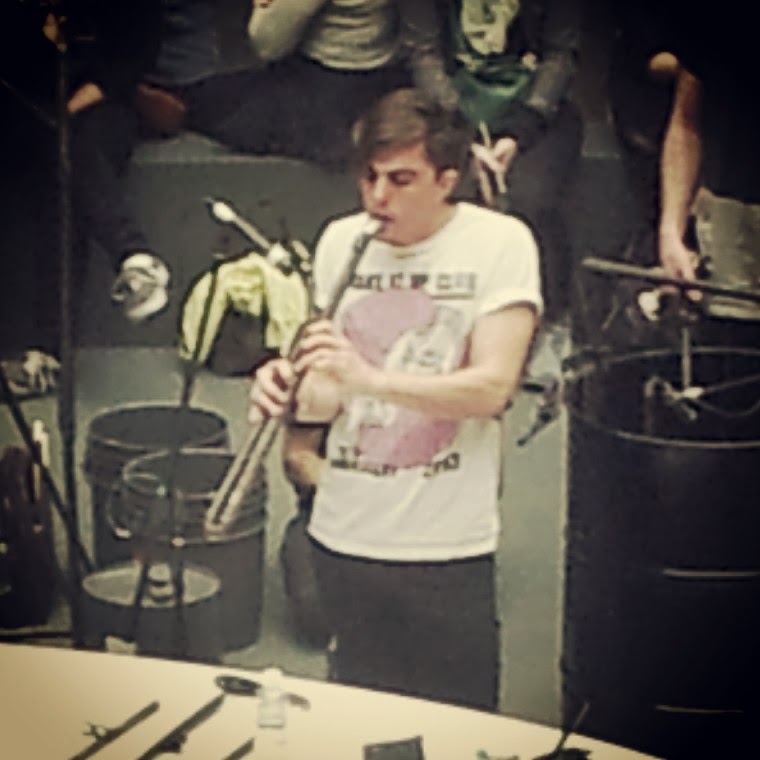
Last Sunday, Nicole and I stumbled upon a music performance at the National Gallery of Victoria conducted with instruments made from weapons - guns, magazines, a pith helmet... Kind of creepy, dark, and beautiful, all at once.

Brought to Melbourne as part of the Melbourne Festival, Disarm is an orchestra set made by Mexican artist Pedro Reyes.
The weapons are a collection confiscated by the Mexican government, and now make music.

The drum kit is made from all pistol pieces.

A saxophone made from the long barrel of a shotgun. The flute was a shotgun, too.

The guitars is fashioned from many ammunition magazines, and barrels of shotguns.

Last weekend Melbourne improv group Make It Up Club played with the collection of instruments for just over half an hour, to a packed space in the middle courtyard space. It was pretty impressive.

We actually went to the NGV for the Art Deco Fashion exhibit, which is really great and has just opened, but this show was a surprising bonus of the day.

Reyes has talked about making these instruments as a 'redemption of this metal' of weapons that have taken lives. Amazing.

Friday, September 20, 2013

Nek Chard's Rock Garden


We were told on arrival that one of the best things about Chandigarh, one of the "don't-misses", was a rock garden. A collection of things made from junk. Art. This I had to see!

After the other sights of the city, and truth be told, feeling pretty under-whelmed by them all, we reached the entrance to the Garden. Adorned with mosaic of bits of tile, the walls of the outside of the Garden had heron-like birds perched on top - clearly made from concrete and tile pieces.

The tiny window low down in the wall accepted our rupees, and we walked in, bemused at what we were about to experience.


The first sections within the maze of Chard's vision create tunnels and low doors, and areas of waterfalls and bridges, platforms and walls of electrical plastic. Originally a dumping ground for industrial and urban waste, there is nothing Chard has not found a use for. The list of materials used include toilet porcelain, discarded street lights, auto parts, play marbles, crockery, human hair recovered from barber shop floors, and broken bangles.


The biggest area, called the Third Phase, is an amphitheatre of mosaic tiles, with a series of archways with swings to play on, a mini-train running around, and a collection of laughing mirrors. Little set up scenes of stories with quirky figures, trees sculpted from concrete. I couldn't make this up if I tried!


The little guys at the top of the post are made with broken toilet bits. The ladies next up owe their colours to the abundance of bangles on Indian girls' wrists. Many creatures are made from these. Amazing! Chard's apprentices have been doing some concrete sculpting for the skirts of the next figures. Plates and bowls make up the background for the guys below.

Enchanting, bizarre, and a world of laughs and surprises. You can see more of my photos from our hours of wandering and marveling here. Definitely one of the most peculiar travel sights I have experienced.

Wednesday, September 18, 2013

You Can't Kill Ideas


We came across this tank with a message in Leisure Park, on our walk among the sights of Chandigarh. It was just sitting on the edge of the park, with it's markings of peace and defiance. This felt like such a different India from down south!

Thursday, August 29, 2013

Monet’s Garden and Footy

When I was standing in line for a MIFF movie earlier this month, I had just managed to wade my way in the rain after an AFL football match at the MCG. Upon seeing the beloved ‘G from Flinders Street, and the stream of footy fans straggling back to the city, the woman in front of me in the line commented that I was certainly making a “change of pace” in my day from one to the other.

I guess that all depended on the pace of the game I had just seen, and the pace of the movie about to be watched, but I just kinda laughed at her incredulous comment that someone who was into film could be into footy as well. I mean, that is the essence of being a Melbournian, and surely a citizen of the world! Follow what you are passionate about, whatever the form!

Nicole and I paired a similar contrast a couple of weekends ago, after our feast at the Melbourne Trailer Park. First up, just up the way on St Kilda Road, we entered the ever amazing National Gallery of Victoria for the Monet’s Garden exhibition.

I am always in awe of the curation at the NGV, they always do things so well! As we weaved through the line to the ticket box we took in the themed décor of the café, which we were to later learn within the exhibit is the kitchen style at Giverny.

After marveling at the abstract version of Monet's waterlillies in the foyer, we moved into the gallery space, and took in the journey of Monet's from his early works and inspiration, to his Waterlilly masterpieces. The acquisition of Giverny, and the development of the garden and lilypond, in addition to the Japanese inspired bridge.

Seeing the garden evolve on his canvases as time moved along, the exhibit also paired his life timelines of love and loss, a fascinating personal history, and the shocking journey of his cataracts, colour vision loss, and repair.

The highlight of the exhibit was Giverny on show - a final room set out as a surround cinema, which takes you through the garden. Having the screens fill your periphery vision, it really felt like you were walking through it - and made me want to add a visit to the real garden to my wanderlust list!

Then we made it across town to Etihad Stadium, to watch the Bombers play the Roos, and my cousin play for the second time this year in the Seniors.

I have discovered that it's so very hard to keep track of just one player during a game. But so very refreshing to watch a game without the emotional investment of having your team in it!

Monet's Garden is on till the 8th of September, and I totally urge you to get along and experience it. The Bombers however, have finally met with the end of a season long saga, and taken their punishment. This coming weekend will be their last for the year.

Wednesday, August 28, 2013

185 Empty Chairs


Returning to Christchurch this month was pretty confronting, seeing the devastation of the earthquakes of 2010 and 2011 and the ongoing state of disrepair of the city. Memories of my visit with Mum back in 2009 made the experience of walking through what felt like a ghost town now all the more.

As I walked around the rubble, nothing was as powerful as the art installation named 185 Empty Chairs.

Out in the open, these chairs, all white, are placed to represent each person lost as a result of the February 2011 earthquake.

All kinds of chairs, which is a moving representation of the ages and range of people the quake took. Some of the chairs in the installation actually belonged to the person for whom it represents.

As Christchurch works away at recovery and the rebuild, this art is a strong symbol of what happened, and the impact these natural forces have had on the city.

Wednesday, July 31, 2013

Gertrude Street Projection Festival


The Gertrude Street Projection Festival finished on Sunday after running for a week, lighting up buildings and spaces all along the street. Some were big rolling spreads on the highrises, some were in shop windows, some were inside exhibits within a gallery, and some were projected on the footpath or road - all unique and captivating.


I met Charles for a drink and then we made our way up the street, taking in the art in the form of light, and popping into a couple of places for drinks along the way.


At first we were underwhelmed with what we saw, but as it grew darker, and the crowds gathered in the street to take it all in, it became clear that there was something whimsical and magical about this little community festival of light.


A hub of activity and art, the street has just enough bars at the right intervals to brace against the Wintery winds of this time of year. Another gem event of Melbourne!

Tuesday, June 11, 2013

A Snail And Others, Roaming Toorak Village


Riding on the tram south of the river in Melbourne, I spotted a flyer about the Sculpture Exhibition being displayed in Toorak Village at the moment, until the 16th. The photos, and the price tags, had me intrigued, so I popped out there on the weekend to have a look.

The snail above was not the only animal roaming this section of Toorak Road, with an Echidna, a "Manrabbit" - and the Mermaids In A Can! Humanly clubbed to death before canning, it reads.


Some of the sculptures are out on the street, and easy to spot. Many are in the participating shop windows, which means you really need to be looking to catch them. Some are in the shop windows in the arcade shopping alcoves off Toorak Road, too.

Ranging from $150, to a whopping $40,000, you take one of these creations home. Some of them have in fact been sold in previous years, and are on loan for the exhibition (the snail, for example), so be careful which you set your heart on!

You can see some more of the ones that caught my eye here. A little sprinkle of art in a suburban shopping strip!

Tuesday, May 21, 2013

Brave Women, Genetics And Genocide, and A Voice: HRAFF '13

The Human Rights Arts and Film Festival has been in Melbourne for the last week and a bit, and I managed to see two short films, two full length stories, and wander through the amazing photography exhibit that accompanying the Fest. The Festival soon tours the country, so these are the ones I saw, loved and was moved by:

Taxi Sister
The story of a female taxi driver in Dakar, Senegal. There are 15,000 taxis, and just 4 taxi sisters among them. The short follows one around over a couple of days, picking up customers, waiting for fares, chatting with other drivers, and just living every day, making her living.

She finds herself having the justify her place in her chosen role to her male colleagues, and explaining that she is alone, having to bring in the money for her family. She no longer had a husband, she explains to the inquiries about why she is not staying home taking care of a man, and that she should be able to work in whatever role she wanted. She's sassy and strong willed, and such an interesting character, showing the world that gender is not a barrier to doing something you want to do.

Red Wedding
250,000 women were forced into marriages during the Cambodian Khmer Rouge period. The political spin was that this was to increase the population, and the new desired workers who were left from the genocide phase were the basis of this new population. This short was one woman's story, of the rape and trauma of her experience, and the lack of understanding about what went on and why.

Incredibly brave, we follow as she shows us the rice paddy where she now works, in the village she lives in, which was once used as a killing field. She tells us the bits of her story she confidently knows, and then confronts members of her village who were part of the arranged marriages and the ruling party at the time, to get a better understanding of it all.

She finds a way to discuss what happened to her with her family, and starts a formal complaint process, in a quest to find some sort of closure, and to help other woman like her. I wonder how she will remain safe as her story is being told to the world through this short film, as she confronts her village leaders, and as she submits her request for a formal investigation. So brave.

Sun Kissed
The story of a Navajo family with two children with the very rare genetic condition called XP. Characterised by skin that burns very, very easily in sunlight, often before diagnosis, and then by the rapid and pervasive neurological degeneration. At the point of the movie, their son had recently passed away, and their daughter was profoundly disabled, requiring peg feeding, and with very limited independent movement.

Initially they thought that they were the only ones experiencing this trial, and the medicine man had told them that their children were like this because when he was young he tortured ants. They had also been told that having children with someone from the same clan would result in children with medical issues, such as their children. But soon, she found other families in the Reservation with children with the same condition, and they started piecing some information together. None of the families she found were parents of the same clan. Some of them, too, had been told that their acts of harming animals when they were kids were the reason for their children having this condition. The impact of religion and cultural beliefs was strong, and the stories carried.

XP is a condition with an incidence of 1 in a million; but here in this region, it was presenting in 1 in 30,000. A significant biological situation.

They manage to speak with a Geneticist and a Historian, and start to hear a connection between this elevated prevalence of this rare genetic disorder to the Long Walk. Essentially, in the late 1800s US military rounded up the Native Americans and kept them within a small geographical area, and initially confining them to a concentration camp of sorts. From here, their population diminished due to the conditions to 5000 people, and it is thought that this mixed clans, and in turn, through the conditions and deaths and pool of Native Americans in one place, confined the gene pool.

This clustering of the Native American clans has meant that the recessive genes are meeting in a match more often, and manifesting in such a rare disorder in this generation of children. Fascinating that it has taken this long to present itself, frightening that there is a sudden surge of incidences of this condition.

Their quest to seek information about how the Long Walk may have impacted took them some time, as no one in their community wanted to discuss it. The past, and bad things such as illnesses, are not discussed in Navajo culture, it was explained. He lamented that this, in turn, meant that so much of their own culture was being lost to them. They no longer spoke some of the languages, and now they were having trouble accessing their history.

Apart from the incredible grief felt for this little family and their loss, the film leaves you with the contemplation of the genetic impact of such atrocities as forced migration on populations, communities, and the future generations - the Long Walk, the rounding up of Indigenous children in Australia, Nazi Germany, the Khmer Rouge genocide....

Requiem
A photography exhibit on display in the Yarra Gallery off Fed Square - here is a room of images selected from the collection shot by the 135 journalists who were killed or went missing during the Indochina War in South East Asia. These prints were taken by Cambodian Nationals and Foreign Press photographers in the battles and weeks before the KR took full command. Some powerful images captured - moment of history - all quashed by the ruling dictatorship/

Words Of Witness
We follow the work and passion of 22 year old budding journalist, Heba Afify, during the Egyptian uprising in Cario in January of 2011. She battles her Mum for permission to be out and interviewing people protesting, and teaches her family about the political situation of the overthrow of Mubarak, whilst she writes and publishes stories and updates for an English news site, and her Twitter and Facebook accounts.

As a young women she faces many barriers, including the perceptions from her own family, about what she should and should not be exposed to, all the while, displaying her passion and excitement for a new political era in her own country.

Wednesday, February 13, 2013

Stickworks

There has been an enchanting house, or 'Ballroom', made of sticks sitting at the edge of Federation Square in Melbourne for some weeks, and it's so cute!

Stickworks is the work of Patrick Dougherty, and was constructed there in the gap next to ACMI, and is part of the Fed Square 10 year celebrations.

It's hard to believe that Fed Square has been there in our city for 10 years. Originally bemoaned as an eyesore, a piece so out of place with the city's surrounding architecture, this piece of modern angles and shapes has now become such a central part of our city, and any Melbournians life, as a meeting place, a place to eat and view the city, and also a place where there is always something going on.


Inspired by the Indigenous works at the NGV, Doughterty has since nicknamed his work 'The Ballroom'. What a grand ballroom it is!

With the size of it, and it's many doors and rooms, you can wander in and weave yourself through the spaces inside. The windows and gaps within the sticks create an amazing light pattern, and also a different perspective of the cityscape around you.

The Ballroom is in Fed Square till the end of the month. Make sure you get down there to check it out, if you haven't already.

Related Posts Plugin for WordPress, Blogger...